Hello hello everyone!
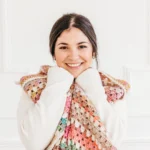
I’m so excited to finally share the Big Patchwork Cardigan with you, a bold, playful knit that brings together everything I love about modern handmade fashion. This design is all about colour, and that effortless oversized vibe that makes a cardigan feel like a warm hug.
If you’ve been craving a project that feels creative and relaxing, this one is for you. The Big Patchwork Cardigan is built from simple shapes, eye-catching colour blocks, and beginner-friendly techniques that come together beautifully. Each square adds a little moment of joy as you knit, and by the end you’re left with a cardigan that truly feels one-of-a-kind.

This post includes affiliate links which help support the content on CJ Design’s blog. My views are entirely my own. For detailed info, please review our Privacy & Disclosures policy here.
I’ve been wanting to bring that patchwork, vintage-inspired vibe into a knit for so long, the kind of cardigan you usually see in sewing patterns, with different fabrics pieced together in a playful, nostalgic way. I wanted that same charm, but knitted..
The Big Patchwork Cardigan was my way of blending that classic, handmade look with the cozy, modern style I’m always drawn to. I wanted something oversized and relaxed, the kind of cardigan you throw on every day, but also something that felt fun and quick to knit. The colour changes keep it interesting, the squares work up fast, and watching the patchwork come together is honestly so satisfying.
Not ready to knit yet? Pin this image and crochet later!

About the yarn 🧶
For the Big Patchwork Cardigan, I chose to use Hue + Me by Lion Brand Yarn, and honestly, it couldn’t be a more perfect match. This yarn is bulky-weight, which means you get that wonderfully chunky, cozy texture and it works up so fast (which is especially great if you’re excited to wear your cardigan ASAP!).
One of the things I love most about Hue + Me is how amazing it looks after washing and blocking. The stitches relax, the slips softly settle, and the colour transitions stay vibrant without losing their crispness. The result is a cardigan that feels substantial and warm, but also soft to the touch and drapey in all the right ways.
Because it’s bulky, each square and each stripe comes together quickly, which keeps the momentum going as you knit. It’s ideal for a project like this, where you want big visual impact without long stress-testing numbers of rows.
Using Hue + Me makes this cardigan not just a joy to knit, but a joy to wear: cozy, polished, and full of character.
About the size
The Big Patchwork Cardigan comes in sizes XS to 4XL, and it’s designed to have that relaxed, comfy vibe that I love. It has dropped shoulders and about 5 inches of positive ease, so the fit is definitely more loose and easy rather than fitted or perfectly structured. This is the kind of cardigan you throw on and instantly feel cozy in.
It also includes buttons, which are totally optional, but I feel like they add such a fun little touch to the final look. Whether you wear it open or buttoned up, the overall fit stays the same. It’s simple, casual and meant to feel like your favourite everyday layer.

Knowing your basic stitches
This pattern is marked as intermediate, but if you’re comfortable with your basic stitches, you’re already halfway there. You’ll need to know how to knit, purl and work simple decreases, since those show up in the sleeves. We also use a few extra techniques that make the cardigan really special, like intarsia for the colour changes and a simple method for creating buttonholes.
Nothing in here is overly complicated, but there are enough little details to keep things interesting. Once you get into the rhythm of the squares and start seeing the patchwork come together, it becomes such an enjoyable project to work on.
If you would like the ad-free printable pattern PDF, you can get it from Etsy or My Shop. If you would like to purchase the kit (yarn+pattern) you can do so from the Lion Brand Website.
Check out more knitting patterns


Video tutorials
Stitches you should know
- Cast on
- Knit stitch
- Purl stitch
- Bind Off
Yarn
Bulky weight yarn #5. Follow accordingly: XS/S(M/L)XL/2XL(3XL/4XL) (number of skeins)
Colour A: 150g/150m (2 sk) (195g/195m) (2 sk) 250g/250m (2 sk) (335g/335m) (3 sk)
Colour B: 150g/150m (2 sk) (195g/195m) (2 sk) 250g/250m (2 sk) (335g/335m) (3 sk)
Colour C: 100g/100m (1 sk) (125g/125m) (1 sk) 160g/160m (2 sk) (215g/215m) (2 sk)
Colour D: 160g/160m (2 sk) (165g/165m) (2 sk) 175g/175m (2 sk) (185g/185m) (2 sk)
I used Hue + Me by Lion Brand in the following colours:
- Pink Earth – Colour A
- Rose Water – Colour B
- Arrowwood – Colour C
- Salt (used for ribbing, cuffs & collar) – Colour D
Notions
Gauge
Stockinette stitch 4”x4”= 10 stitches x 15 rows using 8 mm knitting needles.
Abbreviations
- co – Cast On
- bo – Bind Off
- K2tog – Decrease: Knit 2 together.
- k – Knit
- p – Purl
- RS – Right Side
- WS – Wrong Side
- [] – Repeat sequence in brackets
- St(s) – Stitch(es)
General Notes
- You will need to wash or block your cardigan to achieve the correct fit. If you skip this step, the cardigan will appear noticeably smaller, especially when using the same yarn I used.
- This design has a relaxed, slightly oversized fit with a subtle dropped shoulder. It’s meant to be comfortable and easy-wearing, not a fitted garment.
- The centre back square forms a large part of the collar/neckline area, which creates the slightly dropped shoulder effect. This is intentional and part of the overall design and fit of the cardigan.
- You must make a gauge swatch to ensure your tension is accurate. Skipping this step may result in a cardigan that ends up too large or too small.
Measurements
This cardigan has 5″ of positive ease, considered *Oversized*
Standard bust circumferences used to calculate sizes: XS/S (30″-34″), M/L(38″-42″), XL/2XL(46″-50″), 3XL/4XL(54″/58″)
Techniques
How to Change Colours (Intarsia Method)
For the back and front panels sections we will be working with three colours across the same row. Instead of carrying the yarn across the back, we will be using the intarsia method so each colour block stays clean and the fabric lays flat.
When you reach the stitch where the new colour begins, drop the yarn you were using (don’t cut it) and pick up the new colour from behind the old one. Cross the new yarn under the old yarn and start knitting with it. This little twist locks both yarns together so the stitches stay joined and you don’t get a gap between the colours.
Repeat the same step at each colour change:
- Knit to the colour change
- Drop the old yarn
- Bring the new yarn up from behind the old yarn
- Cross the strands
- Continue knitting with the new colour
This keeps all three colours connected as you work across the row, and each block will sit straight and parallel with clean edges. When you knit the next row, you’ll simply pick up each colour again right where you left it, always crossing the yarns the same way so the fabric stays joined.
Follow the same concept for all rows (knit and purl)
How to make the buttonholes
Using a crochet hook would be very helpful in this process. When you reach the stitch marker, it’s time to make the buttonhole. Work to the marker, then bind off 2 stitches as follows:
- On your left needle, lift the second-last stitch up and over the last stitch, just like binding off.
- Place the remaining stitch back onto the left needle.
- Lift the next stitch over and off the needle (you have now bound off 2 stitches).
- Place the remaining stitch back onto the left needle.
To replace those 2 stitches, cast on 2 new stitches directly onto your right needle using the backward loop method (or any simple cast-on you prefer).
Continue working in 1×1 ribbing until the next stitch marker.
You’ve now created one buttonhole.
About the squares
Keep in mind that this cardigan is designed with square motifs throughout. To keep each square perfectly proportioned, the larger sizes will be slightly longer. Since larger sizes have more stitches across, we need to work additional rows to maintain the square shape.

Pattern
Using colour D and your preferred cast on method, co accordingly: XS/S(M/L)XL/2XL(3XL/4XL)
CO 60(69)78(90)
Ribbing
Row 1: [k1, p1] Repeat the sequence across the row. (Size M/L will have 1 st left, K the last st). (60(69)78(90) sts in total)
Repeat row 1 for a total of 9 rows (for all sizes). Size M/L will begin with [p1, k1].
Body
Please note: There are 28(32)36(42) rows in each colour section.
**Establishing the colour sequence in row 1 (all sizes)**
Row 1 (RS): using colour B, k 20(23)26(30) sts, bring colour A and k 20(23)26(30) sts, bring colour C and k the last 20(23)26(30) sts. (60(69)78(90) sts in total)
Now that colours are established, follow the pattern by changing the colour where it corresponds:
Row 2 (WS): p all the way across. (60(69)78(90) sts in total)
Alternate rows 1 and 2 until row 28(32)36(42).
**Establishing new colour sequence in row 29(33)37(43) (all sizes)**
Row 29(33)37(43): using colour A, k 20(23)26(30) sts, bring colour C and k 20(23)26(30) sts, bring colour B and k the last 20(23)26(30) sts. (60(69)78(90) sts in total)
Row 30(34)38(44): p all the way across. (60(69)78(90) sts in total)
Alternate rows 29(33)37(43) and 30(34)38(44) until row 56(64)72(84).
**Establishing new colour sequence in row 57(65)73(85) (all sizes)**
Row 57(65)73(85): using colour C, k 20(23)26(30) sts, bring colour B and k 20(23)26(30) sts, bring colour A and k the last 20(23)26(30) sts. (60(69)78(90) sts in total)
Row 58(66)74(86): p all the way across. (60(69)78(90) sts in total)
Alternate rows 57(65)73(85) and 58(66)74(86) until row 84(96)108(126).
Your back panel is completed. Do not bind off. We will continue working on the front panels from here.
Front panels
Now, we are going to separate the work into 3 to work the right and left panels.
Right Panel (when wearing it)
Row 1 (RS): Using colour B, k 20(23)26(30) sts (place the remaining sts on hold).
Row 2 (WS): P all the way across. (20(23)26(30) sts in total)
Alternate rows 1 and 2 for a total of 28(32)36(42) rows.
** switch to colour c **
Row 29(33)37(43): k all the way across (20(23)26(30) sts in total)
Row 30(34)38(44): p all the way across (20(23)26(30) sts in total)
Alternate rows 29(33)37(43) and 30(34)38(44) until row 56(64)72(84)
** switch to colour a **
Row 57(65)73(85): k all the way across. (20(23)26(30) sts in total)
Row 58(66)74(86): p all the way across. (20(23)26(30) sts in total)
Alternate rows 57(65)73(85) and 58(66)74(86) until row 84(96)108(126).
** switch to colour d **
For all sizes: work 9 rows of 1×1 ribbing
bind off your stitches, right front panel is now done.
Left panel (when wearing it)
Now let’s go back to the sts that we had on hold.
In the spare cable/strand, you should have 40(46)52(30) sts or 2 colour squares.
Lay your cardigan flat on a clean surface, and with the right side of the cardigan facing you (the same way you had it when starting the right panel), from right to left, leave 1 square or 20(23)26(30) sts on hold (these sts will be part of the collar, PHOTO 1).
The remaining 20(23)26(30) sts or square will be for the left panel.
Insert your working needle from left to right with the right side of the cardigan facing you. This positions you to begin the first row on the right side of the work.
Using colour C, start the left panel:
Row 1 (RS): k all the way across. (20(23)26(30) sts in total)
Row 2 (WS): p all the way across. (20(23)26(30) sts in total)
Alternate rows 1 and 2 for a total of 28(32)36(42) rows.
** switch to colour a **
Row 29(33)37(43): k all the way across (20(23)26(30) sts in total)
Row 30(34)38(44): p all the way across (20(23)26(30) sts in total)
Alternate rows 29(33)37(43) and 30(34)38(44) until row 56(64)72(84)
** switch to colour b **
Row 57(65)73(85): k all the way across. (20(23)26(30) sts in total)
Row 58(66)74(86): p all the way across. (20(23)26(30) sts in total)
Alternate rows 57(65)73(85) and 58(66)74(86) until row 84(96)108(126).
** switch to colour d **
For all sizes: work 9 rows of 1×1 ribbing
bind off your stitches, left front panel is now done.
Sleeves
Before you begin: The sleeves are designed to sit right at the wrist. If you prefer a slightly longer fit, you can add a few extra rows as noted in the pattern. The sleeve starts just above the elbow and measures approximately 11″ in length (including the cuff). If this feels too short for you, simply add rows as needed, every 2 rows will add about ½”, so adjust to your preference.
You are going to pick up stitches on the side of your cardigan to knit the sleeves.
Lay your cardigan flat on a clean surface. From the middle (where the back and front panels meet) you will count 22(26)30(32) sts down on each side and place a marker. (44(52)60(64) total sts for the sleeve) (PHOTO 2)

Right sleeve (when wearing it)
Using colour A, with the right side of your cardigan facing up, start on the right marker and pick up 44(52)60(64) sts.
Row 1 (WS): p across the row. (44(52)60(64) sts in total)
Row 2 (RS): k across the row. (44(52)60(64) sts in total)
Row 3: p across the row. (44(52)60(64) sts in total)
Row 4: k across the row. (44(52)60(64) sts in total)
Row 5: p across the row. (44(52)60(64) sts in total)
Note: If you prefer a longer sleeve, you can add 2 or 4 extra rows at this point. Remember that every 2 rows will add approximately ½” to the length.
Row 6: k, k2tog, k until 3 sts remaining, k2tog, k the last st. (42(50)58(62) sts in total)
Row 7: p across the row. (42(50)58(62) sts in total)
Row 8: k across the row. (42(50)58(62) sts in total)
Row 9: p across the row. (42(50)58(62) sts in total)
Row 10: as row 6. (40(48)56(60) sts in total)
Row 11: p across the row. (40(48)56(60) sts in total)
Row 12: k across the row. (40(48)56(60) sts in total)
Row 13: p across the row. (40(48)56(60) sts in total)
Row 14: as row 6. (38(46)54(58) sts in total)
Row 15: p across the row. (38(46)54(58) sts in total)
Row 16: k across the row. (38(46)54(58) sts in total)
Row 17: p across the row. (38(46)54(58) sts in total)
Row 18: as row 6. (36(44)52(56) sts in total)
Row 19: p across the row. (36(44)52(56) sts in total)
Row 20: k across the row. (36(44)52(56) sts in total)
Row 21: p across the row. (36(44)52(56) sts in total)
Row 22: as row 6. (34(42)50(54) sts in total)
Row 23: p across the row. (34(42)50(54) sts in total)
Row 24: k across the row. (34(42)50(54) sts in total)
Row 25: p across the row. (34(42)50(54) sts in total)
Row 26: as row 6. (32(40)48(52) sts in total)
Row 27: p across the row. (32(40)48(52) sts in total)
Row 28: k across the row. (32(40)48(52) sts in total)
Row 29: p across the row. (32(40)48(52) sts in total)
Row 30: as row 6. (30(38)46(50) sts in total)
Row 31: p across the row. (30(38)46(50) sts in total)
Row 32: as row 6. (28(36)44(48) sts in total)
Row 33: p across the row. (28(36)44(48) sts in total)
Row 34: k, k2tog x 2, k until 5 sts remaining, k2tog x 2, k the last st. (24(32)40(44) sts in total)
**switch to colour d**
Row 35: p all the way across. (24(32)40(44) sts in total)
Now work 9 rows of 1×1 ribbing, you should have 24(32)40(44) sts in total.
Bind off leaving a 10″ tail to sew the cuff later.
Left sleeve (when wearing it)
Repeat right sleeve but with colour b.
Make the collar
** Using colour d **
To knit the collar, you will need to switch to the longest cable that you have.
We are going to pick up stitches from both panels and the neckline (the sts we still have on hold)
Starting at the bottom of your right panel (when wearing it), and with the right side facing up, pick up 84(96)108(126) sts evenly up the right panel (1 stitch per row), then knit the 20(23)26(30) sts that were on hold for the neckline, and pick up again 84(96)108(126) sts down the left panel for a total of 188(215)242(282) sts.
Once you have picked up all the stitches, you can now start knitting the collar.
Row 1: [k1, p1], repeat all the way across the row. (198(200)210(212) sts in total)
Row 2: [k1, p1], repeat all the way across the row. (198(200)210(212) sts in total)
Row 3: [k1, p1], repeat all the way across the row. (198(200)210(212) sts in total)
Row 4: [k1, p1], repeat all the way across the row. (198(200)210(212) sts in total)
We will be making the eyelets for the buttons in the next row (up the left panel (when wearing it)). If you are not adding buttons, skip the eyelets and continue with your 1×1 ribbing.
Place a marker in your 6th stitch, then on every 16th st, for a total of 5 buttonholes/eyelets. Make a buttonhole every time you reach a market (following the instruction on page 2). (PHOTO 3)
Row 5: ([k1, p1] until you reach your marker, make a buttonhole), repeat these sequence until all 5 buttonholes have been made. Then continue your 1×1 ribbing until the end of the row.
Row 6: [k1, p1], repeat all the way across the row. (198(200)210(212) sts in total)
Row 7: [k1, p1], repeat all the way across the row. (198(200)210(212) sts in total)
Row 8: [k1, p1], repeat all the way across the row. (198(200)210(212) sts in total)
Row 9: [k1, p1], repeat all the way across the row. (198(200)210(212) sts in total)
Bind off your stitches with tight tension.
Assembly
Use binding clips or stitch markers to line up all the squares along the sides so everything stays neat and aligned.
With your preferred seaming method, begin sewing the sides of the cardigan. Start at the sleeve cuff, work up to the underarm, then continue down the side of the body. Use the cuff tail to sew the cuff with the matching colour, and for the rest of the seam choose one of the colours that appears throughout the squares.
Repeat the same steps on the opposite side. (PHOTO 4)
Before adding the buttons, wash/dry or block your cardigan.
Finally, close the front of the cardigan flat and mark where the buttons should go. Use regular sewing thread or a piece of yarn to attach the buttons securely. (PHOTO 5)
Your cardigan is now ready to wear!

Approximate Measurements

XS/S
1: Shoulder to hem: 22.8″
2: Back panel width: 21″
3: Front panel + sleeve: 18″
4: Sleeve circumference at its widest point: 13.5″
M/L
1: Shoulder to hem: 26″
2: Back panel width: 24″
3: Front panel + sleeve: 19″
4: Sleeve circumference at its widest point: 16″
XL/2XL
1: Shoulder to hem: 29.3″
2: Back panel width: 27″
3: Front panel + sleeve: 20″
4: Sleeve circumference at its widest point: 18.5″
3XL/4XL
1: Shoulder to hem: 34″
2: Back panel width: 31.3″
3: Front panel + sleeve: 21.5″
4: Sleeve circumference at its widest point: 19.7″